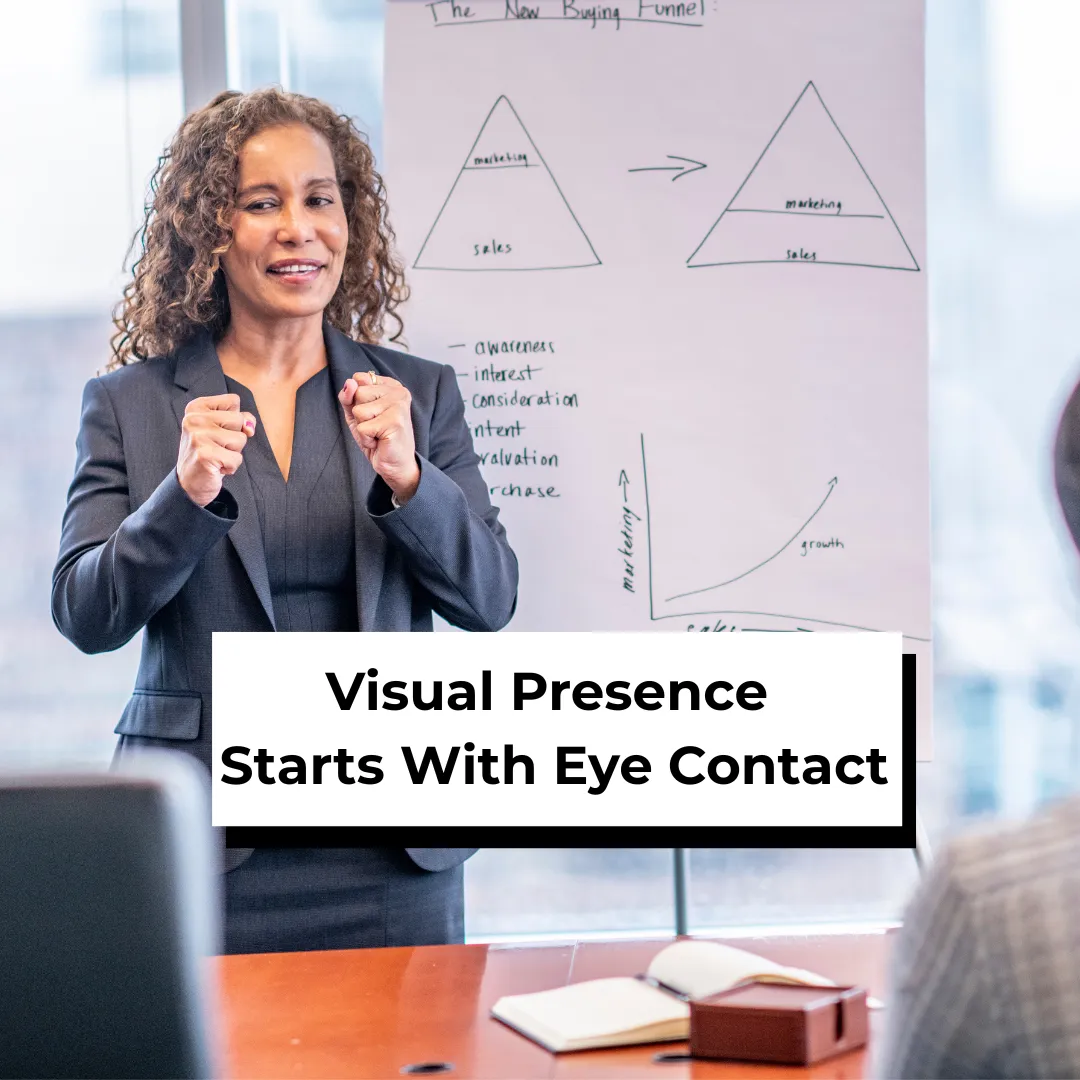
From Avoiding Eye Contact to Owning the Room: How to Build Your Visual Presence
You’ve done the prep. You’ve got the content. But when it’s time to speak, your eyes look down at your notes, the floor, the PowerPoint, anywhere but at the people in front of you.
Does that sound familiar? This is more common than you think.
Many smart, capable professionals struggle with making direct eye contact when presenting or speaking in groups. While it may seem like a small thing, making eye contact (or not) has a major impact on how your message is received, and how you're perceived.
So, let’s talk about why eye contact matters, what gets in the way, and how you can build what I call visual presence; the ability to meet the gaze of the people in the room and project your message with calm confidence.
Why Eye Contact Matters in Leadership Communication
Making eye contact is more than just a social norm. It’s one of the clearest signals we can use to engage our audience, demonstrate presence, and build trust.
Consistent eye contact:
Enables you to connect with your audience
Signals confidence and belief in what you are saying
Keeps listeners engaged and focused
Reinforces your credibility
When your eyes avoid the people in the room, your audience feels: discomfort, uncertainty, and detachment, even if that’s not what you intend them to feel.
Why You Might Avoid Eye Contact (Even When You Don’t Mean to)
Avoiding eye contact doesn’t always mean you lack confidence (though it can sometimes signal that).
Often, it’s more about:
Nervous system overload:
In high‑stakes situations, looking directly at people can feel too intense or overstimulating.
Mental overdrive:
You may be thinking so hard about what to say or how you’re coming across that you simply forget to visually engage.
Cultural conditioning:
In some cultures, direct eye contact is considered rude, invasive, or confrontational, so people are taught to limit it.
Personality tendencies:
Strong introverts or people who are naturally shy are often less comfortable with prolonged or direct eye contact.
Whatever the reason, this is a habit you can shift, with awareness, clear intention, and deliberate practice.
How to Build Visual Presence, without Forcing It
Let’s be clear: this isn’t about locking eyes in a static stare, or making people uncomfortable. It’s about finding your version of calm, steady eye contact.
Here’s how:
1. Start Small
Pick a person in the room and hold their gaze for a one to two seconds. Then shift to another person and do the same thing. Build your ability to gaze at people gradually.
2. Breathe Before You Look
Taking a deep breath before you connect with your eyes grounds your nervous system and can help you soften your gaze, making the experience less intense.
3. Try the Triangle Technique
Instead of forcing constant, direct eye contact, you can use a simple coaching tool sometimes called the “triangle technique”:
Gently let your gaze move within a small triangle between the person’s eyes and upper face (left eye, right eye, forehead). To them, it feels like natural eye contact; to you, it feels less intense and easier to sustain.
4. Practice in Low-Stakes Settings
Team meetings, virtual calls, or even one-on-ones with people you know well can be great practice arenas. If you get comfortable making eye contact when the pressure is low, you’ll be able to transfer that skill to higher-stakes situations.
5. Get Feedback from a Trusted Source
Sometimes, we think we’re looking directly at people enough, when we’re not. A coach, colleague, or video recording can offer helpful insight.
From Hiding to Holding Attention
Eye contact isn’t just a technical skill, it’s a trust-building tool. When you allow your eyes to meet another’s, you signal confidence not just in your message, but in yourself.
If you’ve been avoiding eye contact because it feels too vulnerable, intense, or unnatural, don’t beat yourself up.
With intention and practice, you can shift from avoiding to being fully present.
You may have to “fake it till you make it” at first, but with practice you’ll be able to present with your eyes wide open.
Want help building your visual presence?
My coaching is designed to help professionals communicate with clarity, authority, and ease, even if confidence doesn’t come naturally. Whether you’re an introvert, a non-native English speaker, or someone who just wants to feel more grounded when presenting, I can help.