How to Prepare for a Panel Discussion and Be Remembered | Boldt Global
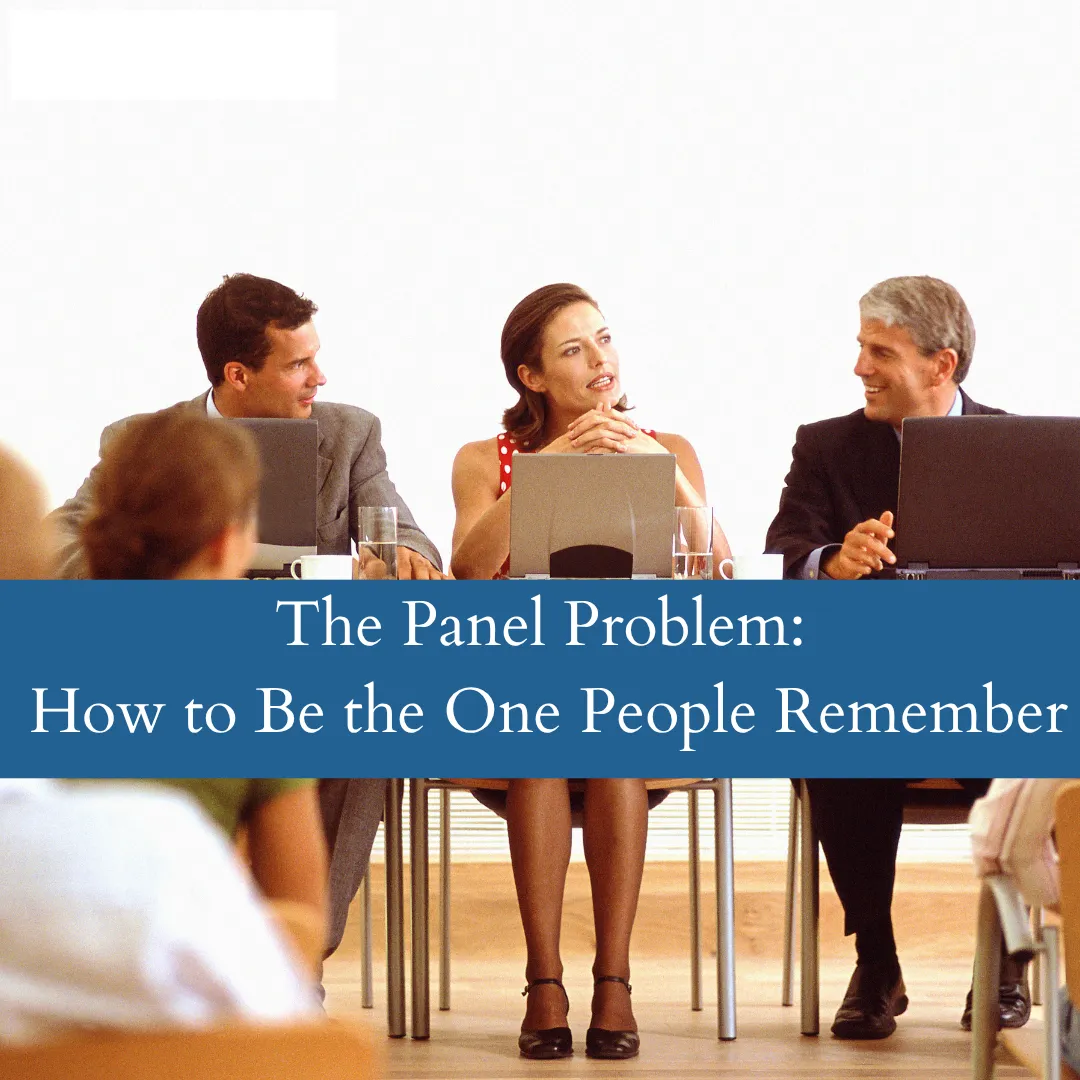
Rarely do people walk out of a conference talking about a whole panel discussion.
More likely they leave talking about what one person said. One panel member says something that sticks, and for the rest of the afternoon people repeat it in the hallways, at the coffee station and pass it on later in a message to a colleague who missed the event.
The other four people on that stage were also intelligent and well prepared, but they were also entirely forgettable. Why?
This is the part that surprises people. It is frequently the most prepared and thorough panelist who gets forgotten.
Start with the math
A panel with five members and a moderator often runs for about forty-five minutes. If we subtract the moderator's introduction, the questions themselves, the transitions, and the audience Q&A at the end, what's left is somewhere between three and six minutes of speaking time per panel member.
And you don't get it in one chunk. You get it in roughly 90-second fragments scattered throughout the session. That's your entire budget.
And don't forget, the topics are chosen by the moderator. Everything the people in that room will ever remember about you will be said in fragments.
Now let's consider how most executives prepare to be a panel member: many prepare the same way they would prepare for a presentation. They think about the context, they explain the nuance, they aim to cover the topic thoroughly, because that is what they know how to do.
When it's their turn to respond, they begin their answer at the beginning, their beginning, even if some of that ground has already been covered by another panel member. They get to the interesting part around second seventy just as the moderator glances at the person to their left. And voilà, they never get to give their wisdom.
Being thorough on a panel is not a virtue. It makes you disappear.
The economy of ninety seconds
The answer the memorable panelist gives is not necessarily more impressive. It is just built for the format.
They lead with the point they want to make, then explain it. If the answer to the question is that most companies are measuring the wrong thing, that sentence comes first and the reasoning follows. If the moderator cuts them off at second sixty, the room still got the point.
Another thing the memorable panelist does is to say one thing rather than three things. Trying to deliver three ideas in ninety seconds means the audience remembers none of them, while giving one idea in ninety seconds has room to land.
Memorable panelists also use specific examples that allow the audience to grasp their point. A number, a moment, something that actually happened. Abstraction makes panel answers blur together, while specifics make your answer pop.
None of this means you need to be quotable by nature. But it does mean you have to decide, before you open your mouth, what one concise sentence can make your point clearly.
Other mistakes panelists make
Running out of time is the big one, but it is not the only way capable people make themselves forgettable. Two more are worth naming.
The first is wasting your introduction. When the moderator says, "Let's go down the row and introduce yourselves." you have about twenty seconds. Most people spend them reciting a title and a company name the audience already has… it is in the programme and on the screen behind you. What they do not have is a reason to lean toward you rather than the person beside you. Compare "I'm the VP of operations at a mid-sized manufacturer" with "I run operations for a manufacturer, and I've spent three years being wrong about automation, so I have opinions." Same person, same job, but the second intro makes the room want to hear from them. You do not need to be clever, just specific about what you bring that the other four do not.
The second mistake hides inside four gracious-sounding words.
"I agree with what she said."
These four words hand YOUR airtime back to someone who has already used theirs.
It feels gracious. It is collegial. It is also the most common way capable people waste their turn on a panel.
A panel is not a consensus exercise. Nobody assembles five people so the audience can watch them nod at each other, and nobody in the room came to hear the same answer five times in slightly different words. They came for the different angles. Contrast of opinion is the entire reason the format exists.
This is where a lot of senior people get stuck, because agreeing feels safe and disagreeing feels dangerous. But there is a wide, open territory between "I agree" and "you're wrong," and nearly all interesting ideas live in it.
"That's true in a large organization. It falls apart under fifty people, and here's why."
"I would have said exactly the same thing two years ago."
"I think the risk actually runs the opposite direction."
None of those statements are combative. All of them give the audience something they did not already have. And if you genuinely do agree, say so in three words, then add the piece only you know.
Prepare positions, not paragraphs
Here is the practical difficulty. You cannot rehearse verbatim answers for a panel. You do not know the questions, the order, how much time you will get, or what the person before you will already have said.
So, people do the thing they know how to do, which is to prepare paragraphs. When the moderator asks something adjacent to what was rehearsed, the paragraph still comes out and everyone in the room can hear it land slightly off the question.
My suggestion is to try a different kind of preparation. Instead of scripting answers, decide on your positions.
Choose three points you genuinely believe about the subject. Not observations. Points you would actually argue for over coffee with a colleague who disagreed. For each one, have a story or a number that makes it concrete.
That is the whole preparation. Three positions, three pieces of evidence, and it fits on a note card.
Now you are not hunting through a rehearsed script for something that fits the question. You are choosing which of your three points is most relevant to what was just asked, and you can start talking immediately, in your own voice, without the delay that makes people sound uncertain.
You cannot rehearse an exact panel question, but you can decide what you believe about the topic before you get there.
For anyone who freezes when they get lost in their script, there is an upside to speaking on a panel… there is no script to get lost in. Some of my clients who dread public speaking find panels easier than keynotes for exactly that reason, especially once they understand how to prepare.
The invitation is not the opportunity
Being invited onto a panel is flattering, and it is easy to treat the invitation itself as the win. But it’s not. The room will form either a positive or a negative view of you, and three unremarkable minutes is a loss, not a win.
The good news is that the bar tends to be low. Most panelists are careful, thorough and instantly forgettable. Deciding what you believe beforehand, leading with it, and saying one thing at a time is usually enough to be the person people quote in the hallway.
That is a pretty small amount of preparation for a disproportionate return.
Conference season is here
If you have a panel on the calendar this autumn, let's work out what your three positions are before someone hands you a microphone. Schedule a Discovery Call with Barbara.