Little Words that Are Costing You Big: How Filler Words Undermine Your Credibility
Picture this: You've spent weeks preparing for a high-stakes presentation. You know your material. You're dressed for the part.
But when you open your mouth, out comes a stream of sentences punctuated by "um, so, um, basically, and then, you know...".
Your audience tries to follow what you are saying. But somewhere around minute three, their attention starts to drift, not because your content is weak, but because listening to you has become hard work.
Filler words are the equivalent of static on a phone call.. You're speaking, but your message is interrupted by repetitive words that don’t add meaning, causing it to not land the way it should.
The hard truth? Most people are unaware of how many filler words they use, or the impact of those words on the people listening.
Why Filler Words Are More Damaging than You Think
Filler words aren't just a verbal tic. They distract your listener, and disrupt your message, decreasing your ability to communicate clearly.
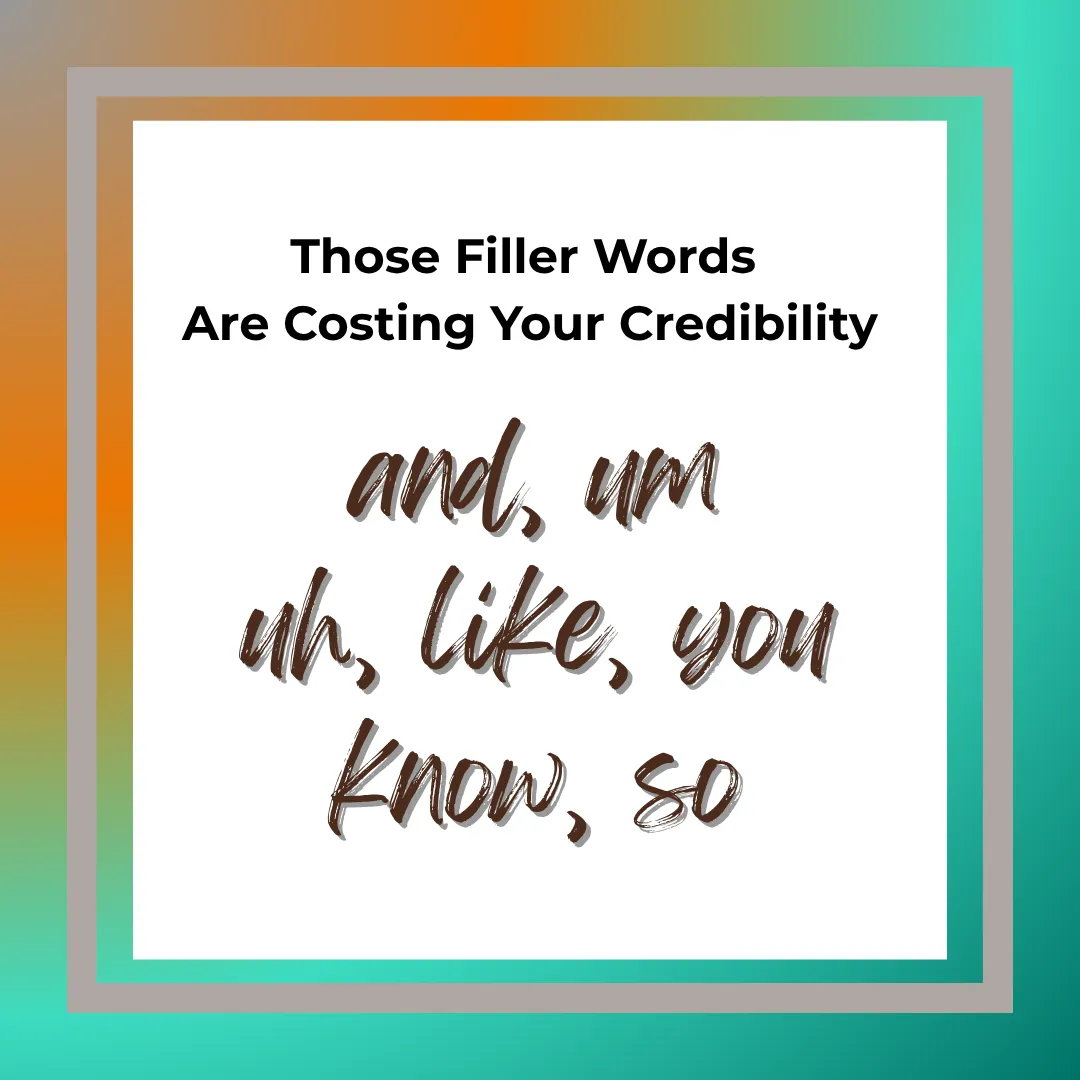
When you pepper your speech with "um," "uh," "like," "you know," "so," or "right," your listeners may perceive you as hesitant or uncertain. They may think you lack command of the language or your own message. And maybe unconsciously, their confidence in you starts to erode.
For leaders and professionals, the stakes are especially high.
Think of the moments in your career that matter most:
• Pitching an idea to senior leadership.
• Advocating for yourself in a performance review.
• Leading a team meeting.
• Making a conference presentation where you're positioned as an expert.
In every one of these situations, filler words work against you. They interrupt your listener's ability to understand your thinking. They chip away at your executive presence, and over time, they can cost you the recognition, influence, and advancement you deserve.
The Sneakiest Filler Word of All: "And"
Most people know that the sounds "um" and "uh" are something to cut out. But there is a far more insidious filler word hiding in plain sight, one that almost no one catches themselves using.
The word "and."
Here's how it typically sounds: "We completed the project on time and the client was thrilled and we're now looking at a follow-on engagement and I think there's a real opportunity here and we should move quickly."
Notice what happened there? All of the thoughts got stitched together with "and", whether they were related to each other or not. The speaker was thinking about what to say next, so they used "and" as a filler and ended up attaching all of the phrases.
The problem? Not all of those ideas are related to each other. When you connect unrelated thoughts with "and," your listener's brain works to figure out the logical connection that isn't there. The result is confusion and fatigue for the listener and a speaker who sounds like they're rambling rather than leading.
If the thought is new, start a fresh sentence with a subject, a verb, and an object. Your listener will hear the clarity of the distinct sentence and you will sound more authoritative and be easier to follow.
Here is a re-write of the example above: "We completed the project on time and the client was thrilled. We're now looking at a follow-on engagement. I think there's a real opportunity here so we should move quickly."
Generally, “and” fits between two phrases in the middle of the sentence, but it shouldn’t be used to start a sentence. When speaking, the fix is simple but powerful: when you feel the urge to say "and," pause instead. Ask yourself whether the next thought is a continuation of the previous one. If it does, the "and" belongs. If it doesn't, give your new idea the gift of its own sentence.
Meet the Rest of the Usual Suspects
While "and" might be the most overlooked offender, the other common filler words are doing damage of their own:
"Um" and "Uh"
These are the filler sounds most people are aware of and dread. They can be hard to eliminate, because they're deeply habitual. "Um" and "uh" are thinking sounds. They are used when your brain is searching for the next word or thought. The antidote is to become aware of the habit, then gradually eliminate these distracting sounds. Initially you will catch yourself after the fact, but if you keep with it, your brain will eventually stop the sound from coming out of your mouth. You will pause, which means you will also slow down. Silence sounds far more confident than "um" or “ah”.
"Like"
"Like" has migrated far beyond its grammatical home. When used as a filler — "I was like, kind of thinking we should like, move in a different direction" — it softens your message to the point of being meaningless. It also tends to make speakers sound younger and less certain of themselves than they are, which is the opposite of the executive presence most professionals are aiming for.
"So" at the Start of Every Sentence
Starting every sentence or new idea with "so" is very common in professional settings. "So, what I'd suggest is..." "So, the data shows..." "So, I think we need to..." When "so" appears once, it's fine. When it appears at the beginning of every single sentence, it starts to sound like a verbal placeholder, and your listeners notice, even if they can't name it.
"You Know" and "Right?"
“You know” is my personal pet-peeve. It is often used repetitively in situations where the speaker is informing the audience about something they DON’T know! “Right” is asking the listener to agree with what you're saying rather than committing to your message with confidence. For leaders, these two fillers are especially worth expunging because they subtly shift the dynamic from "person in authority" to "person who isn’t sure."
What Filler Words Might Be Saying about You
Here's the uncomfortable truth that some communication coaches won't say out loud: filler words aren't just a bad speech habit. For many professionals, they're a symptom of something deeper.
They show up when you’re not feeling confident.
When you're anxious about being judged.
When you're speaking faster than your brain can organize your thoughts (maybe because you’re nervous).
When you're afraid of silence.
Recognizing your own use of filler words, and understanding what's driving them, is the first step toward speaking with the kind of clarity and confidence that turns heads and opens doors.
Communication skills aren't fixed traits you either have or don't. They're modifiable and learnable. With awareness and practice, even deeply ingrained habits can be changed and the impact on how others perceive you can be remarkable.
Practical Steps to Start Cutting the Static
If you know you are guilty of using filler words, the good news is you don't need to overhaul your entire communication style overnight.
Here are some simple things you can do:
Record yourself practicing something you need to say. A voice memo will reveal patterns you've never noticed.
Ask a trusted colleague to count your use of filler words during a meeting. The number might shock you.
Practice intentionally pausing when you feel the urge to fill a silence, or can’t think of the next word. Well-placed, intentional pauses signal confidence, not uncertainty.
Slow down. Filler words often appear when we're speaking faster than we can think. Give your brain a moment to catch up before you say the next thing.
Deliberately break the "and" habit. For one week, notice every time you start a sentence with "and." Ask yourself whether it belongs there. Practice starting a new sentence for every new idea.
Ready to Speak with More Clarity and Confidence?
If you recognize yourself in any of the patterns above, not to worry. You don't have to figure out how to solve this problem on your own. In my coaching, I help leaders and professionals identify the specific habits that are holding them back and replace them with communication patterns that project presence, authority, and clarity.
The shift doesn't take years. Sometimes it takes just a few sessions to break a bad habit and start showing up differently.
👉 Schedule a free discovery call today and let's talk about what's possible when you communicate with the confidence your ideas deserve.