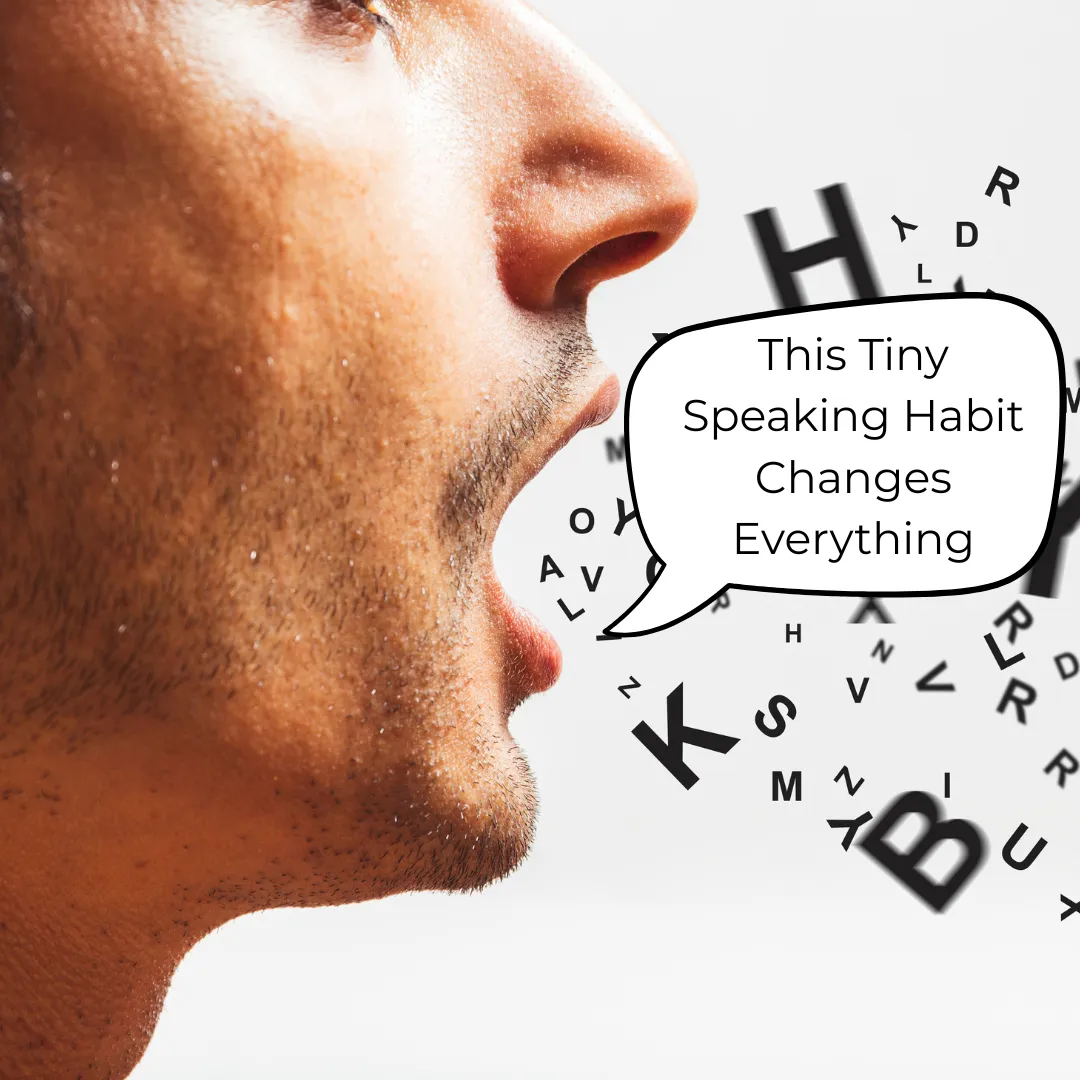
Why Enunciation Is Your Super Power for Leadership Communication
If you feel your communication isn’t getting through, you might not have a content problem.
You might have a delivery problem.
Let’s make this uncomfortable for a second.
You speak in a meeting.
Someone says, “Sorry, I didn’t catch that. Can you repeat?”
You repeat what you said.
Then someone responds to what you said, but what they say isn’t quite aligned.
Or the person nods in that way that tells you they didn’t fully catch .
So you start adjusting your content.
Explaining more. Rephrasing. Adding detail.
But what if the issue isn’t what you’re saying?
What if people aren’t connecting with your message,
because they’re not hearing it clearly in the first place?
What Enunciation Is (and Why It Matters More than You Think)
Let’s dive into message delivery.
When we talk about how a message is delivered, there are two aspects:
1. Vocal delivery — how your voice carries and impacts the message
2. Physical delivery — how your body language supports the message
Enunciation sits squarely in that second category: vocal delivery.
A concise definition:
Enunciation is the clear, distinct speaking of words so your audience can understand them easily.
It means:
Forming sounds cleanly by engaging the muscles around your mouth and in your face
Not swallowing word or sentence endings
Making word and sentence boundaries clear
Speaking with enough precision that your audience doesn’t have to guess
Because here’s the reality:
If people have to work too hard to understand you…
they stop listening.
And when that happens:
People are confused
People don’t connect with your message
They don’t connect with your message don’t get the response you need
And you don’t get the response you need
The Problem No One Talks about (but Everyone Hears)
I hear this all the time when listening to podcasts or interviews on the radio.
Smart, capable people, saying valuable things…
…but their words are not distinct.
Endings disappear.
Sounds get softened.
Sentences run into each other.
As a listener, I find myself leaning in, trying to piece it together.
I’m interested and I wanted to get it,
but because the delivery is unclear, I have to work at getting the meaning.
And sometimes I just give up.
This doesn’t happen only on podcasts.
It happens in:
Meetings
Presentations
Client conversations
High-stakes moments where clarity matters most
And here’s what most people don’t realize:
Improving enunciation is not that hard!
All you have to do is intentionally use all of the muscles in your face and especially around your mouth as you speak.
Why People Don’t Enunciate (even Highly Capable Professionals)
When speaking, most professionals are focused on:
Getting the words right
Sounding intelligent
Not making mistakes
So what happens to some of us?
We tighten up.
Our jaw restricts.
Our lips barely move.
We drop the energy at the end of words.
The result?
Words are clipped
Sounds blur together
Even though the content is solid…
The meaning gets diluted.
The Hidden Cost of Poor Enunciation
Poor enunciation doesn’t just affect clarity.
It also affects perception.
When your words aren’t clear:
You sound less confident
You come across as nervous or unsure
Your authority is weakened
Over time, the gap between what you know and how much you are perceived to know
grows.
The Shift: It’s Not Just What You Say
This is the point I want you to take away:
You must pay attention to how you’re speaking, not just what you’re saying.
Because even the best ideas can be overlooked if they’re not delivered clearly.
Simple Ways to Start Improving Your Enunciation
Improving anything starts with awareness.
Do you know how clearly you speak?
Here’s how to find out:
1. Record yourself (yes, really) and listen back
Listen for:
Words blending together
Dropped endings
Words that are indistinct
You’ll hear sounds you don’t realize that you are making.
2. Intentionally finish your words
Pay attention to pronouncing word endings:
“ing”
“t”
“d”
Many people drop them under pressure.
Slightly emphasize the end of words, not dramatically, but enough to complete the sound.
3. Move your mouth muscles more than feels “normal”
This is where most people underestimate what’s needed.
Clear speech requires:
Active lips
A mobile jaw
Full use of your mouth and the muscles around it
At first, activating these muscles will feel like you are exaggerating and may feel ridiculous.
But what you say will sound clearer to everyone else.
4. Slow down just enough
When pace increases, enunciation suffers.
You don’t need to speak too slowly,
but you do need to give your mouth time to form the words fully.
5. Maintain your vocal energy all the way to the end of the sentence
Many people start a sentence strong, but the volume or energy fades by the end.
That drop in energy causes the last part of your sentence to become indistinct, hard to hear.
Keep your energy constant all the way through the entire sentence.
Final Thought
If you’ve ever walked out of a meeting or conversation thinking:
“People aren’t connecting with me.”
“I’m not getting the response I need.”
It’s worth asking yourself:
Was my message unclear? Or was I speaking in such a way that it could not be clearly heard?
When you pay attention to how you enunciate, something powerful happens:
People understand you the first time.
They stay engaged.
And your message starts to land the way it was meant to.
Ready to Take This Further?
If you want to understand how your voice and delivery are impacting your presence and how you're perceived, get in touch.
We’ll look at what’s happening with your communication and identify specific adjustments that will make the biggest impact.
Remember, clarity is rarely about saying more.
It’s about saying just enough in a way that can be understood.